The General
The SympathizerThe General is a career soldier and former head of the National Police of the Republic of Vietnam whose authority is tested first by the evacuation of Saigon and then by the diminished life of exile. A veteran who has survived combat and imprisonment, he responds to defeat not by abandoning his military identity but by rebuilding it: in America, a restaurant becomes a base for an anti-communist movement, and former soldiers are gathered into a force meant to return to Vietnam. His story is also one of hard limits. He can revive the appearance and discipline of an army, but his command depends on an abstract promise of national liberation, and his loyalty to family and hierarchy can override the personal bond he has formed with his trusted aide, The unnamed narrator.
Identity and military formation
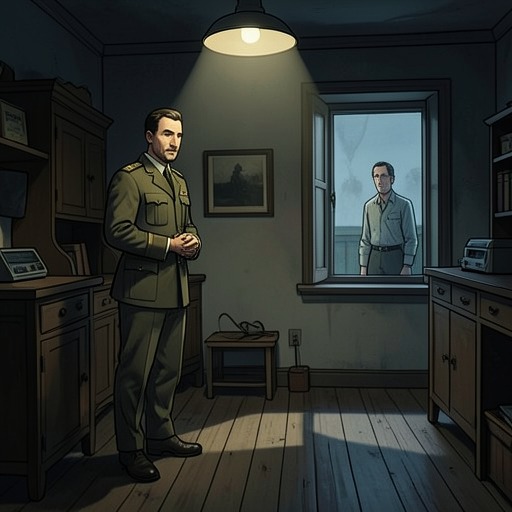
A thin man with excellent posture, The General is described as a veteran campaigner whose medals were earned rather than merely worn. Bullets and shrapnel cost him three digits, leaving him with nine fingers and eight toes; the condition of his left foot is known only to his family and confidants. His physical losses are not presented as a departure from military life: they mark the body of a commander shaped by combat, even as he remains fastidious about posture, dress, and authority.
His professional life joins military service to state power. He had served in the Airborne before the president called on him to lead the National Police of the Republic of Vietnam. At home, he relies on The unnamed narrator, his aide-de-camp and junior intelligence officer, to prepare notes on communist writings, including The Communist Manifesto and Mao’s Little Red Book. The General does not read those works himself, but he uses his aide’s summaries to perform knowledge of the enemy. He repeatedly borrows a famous question associated with Lenin, while The unnamed narrator recognizes that the formulation originated with Nikolay Chernyshevsky. The episode captures a leader more interested in making an idea politically useful than in tracing its intellectual provenance.
His convictions are at once political, familial, and personal. He is a Christian and an epicurean, with gastronomy ranked ahead of religion, and he prizes his wife and children alongside the French and Americans, whom he considers better guides for Vietnam than communist leaders. His tastes are exacting: he wants a good bottle of Bourgogne and companions who understand that wine is not to be served with ice. Such refinements distinguish the household he presides over from the military emergency gathering beyond its walls, but they do not make him indifferent to danger. As eighteen enemy divisions close around the capital, he knows that the government’s end is near.
Command during the evacuation
The General’s domestic life and command responsibilities meet at the evacuation. He lives with his family in his villa, where The unnamed narrator is the only officer on the staff who also resides in the house. At breakfast, the two men review dispatches at one end of the teak dining table while Madame supervises the children at the other. One place remains empty for a daughter studying in America. The arrangement gives the aide unusual intimacy with the family, but it also keeps the chain of command visible inside the home.
When Claude can arrange only one unlisted C-130 flight, with room for ninety-two paratroopers and their equipment, The General points out that his extended family alone numbers fifty-eight. He may dislike some relatives, but he knows Madame will not forgive him if he leaves them behind. The problem is not simply how to escape; it is how to decide who belongs on the plane when the people closest to him exceed its capacity. Later, The General defers the detailed evacuee list to The unnamed narrator while attending to the work of his office and discussions about holding the city even as officials prepare to abandon it. His aide experiences every name crossed off as a sentence of death, making the logistical task carry the burden of personal judgment.
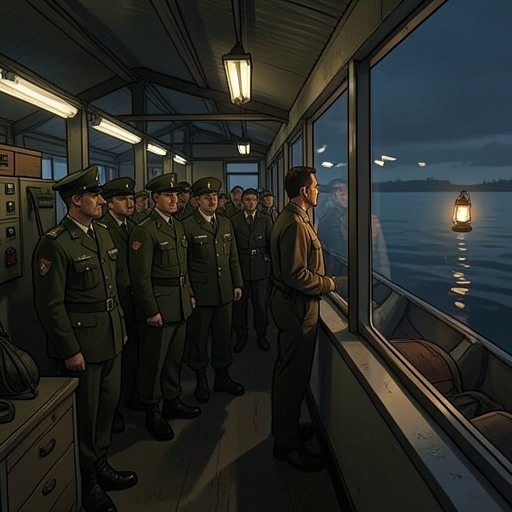
At departure, two blue buses wait outside the villa. Families board with small cases, blankets, and dolls; Bon arrives last with his wife, Linh, and their son, Duc, who carries a yellow yo-yo given to him by The unnamed narrator. The General’s farewell to the household staff reveals the human cost of the list. He cannot meet the old butler’s eyes, apologizes for taking the family and officers while leaving the servants behind, and promises that they will not come to harm. He tells them to take what they need and deny having worked for him if questioned, yet insists that he will continue fighting for the country. When he begins to weep, The unnamed narrator hands him a handkerchief. The General’s authority does not prevent grief; here, it makes him answerable for those he cannot rescue.
Exile and the return project
In America, military defeat has reduced The General to work as a liquor-store proprietor and later a restaurateur. He regards the restaurant as degrading, and its worn linoleum, grease-speckled walls, dull yellow paint, and harsh overhead lights fall far below the establishment he would have chosen. The waiters are veterans of the Special Forces and Airborne, but in trucker caps and ill-fitting shirts they look like ordinary service workers rather than the fighters they once were. The General’s humiliation is therefore not only economic. His men have lost the visible signs through which they understood themselves as soldiers and leaders.
The restaurant also becomes the practical cover for renewed political activity. Madame’s cooking draws Vietnamese customers to the small Chinatown establishment, where every table is occupied by people eating and speaking their native language. The General presents the enterprise as nonprofit: its profits go to the Movement, and customers can understand their meal as a contribution to the cause. The arrangement is an open secret—known and not openly discussed. Madame handles uniforms, a women’s auxiliary, and flags; she has also organized a Tết celebration in Orange County featuring veterans in camouflage. The restaurant makes a taste of home available to refugees while turning the business into a resource for a movement that hopes to return home by force.
The General’s ambition is not merely to assemble a crowd. He has spent more than a year building a nucleus of roughly two hundred volunteers, beginning with officers, then recruiting trusted noncommissioned officers and enlisted men through them. The planned structure includes a headquarters platoon, three rifle platoons, and a heavy-weapons platoon, though the weapons themselves have not yet been acquired. He expects to obtain them in Southeast Asia. His immediate program is to restore discipline, condition bodies, and teach the volunteers to imagine themselves as an army again. A reconnaissance team is to go to Thailand, meet a forward field base, and identify an overland route into Vietnam.
During a training gathering, The General appears in battle camouflage tailored by Madame, with a red beret, polished field boots, stars on his collar, and an Airborne patch on his sleeve. The uniform reverses the visual terms of exile: men otherwise working as busboys, gardeners, fishermen, laborers, or custodians stand upright and march instead of slouching or shuffling. The General addresses them as leaders capable of giving the people hope and calls for the volunteers to risk their lives. His appeal treats the people as a source of legitimacy, although the narrator notes that no one specifies who the people are or what they want. The very vagueness of the idea helps it bind the men together. The General’s military staging restores dignity to the volunteers, but it also makes self-sacrifice easier to demand.
Loyalty, authority, and rupture
The General’s relationship with The unnamed narrator begins in trust and proximity. The aide lives in his house, drives him to work, attends meetings with Americans, handles intelligence, and is assigned responsibility for the evacuation list. In exile, The General still calls on him as an intelligence officer. Yet this closeness does not erase the difference between patron and subordinate. When he considers letting the aide return to Vietnam, The General contrasts him with battlefield-tested veterans and tells him he must prove he can do what must be done. Recounting his own volunteer jump into Dien Bien Phu, where he was captured and spent two years in a communist prison camp, he presents personal risk as a duty understood without an explicit order. He promises to arrange a ticket after receiving news that the unnamed task has been completed, leaving the details to his intelligent subordinate.
His suspicions of Sonny show how the General’s political caution can become an accusation. Sonny’s newspaper article about reconciliation and rebuilding sounds appealing to refugees, but The General argues that return could mean a bullet or a long stay in reeducation, and that communist authorities would benefit from the hope the article offers. He asks whether Sonny might have been sent to America to spy on the exiles and undermine them. When The unnamed narrator admits that Sonny had shown sympathies in college, The General reproaches him for failing to recognize the danger. He identifies excessive sympathy as a weakness in his intelligence officer, placing political vigilance above their friendship and the aide’s capacity to see an opponent as more than a threat.
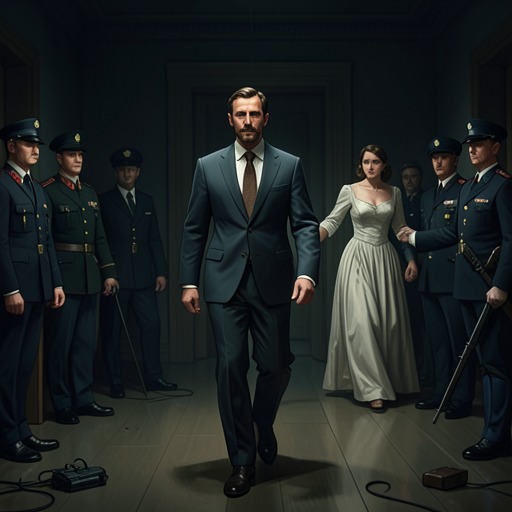
That hierarchy reaches its sharpest expression at the airport, when The General and Madame confront The unnamed narrator about his apparent pursuit of their daughter. The General says he and Madame had regarded him as an adopted son, but explains that they would never permit their daughter to be with someone of his kind: he is a bastard. He frames the rejection as a rule of proper place, not as a negotiable disagreement. The insult exposes the limit of his paternal affection. The man trusted to live in his home and serve his cause can be treated as family until intimacy challenges the social boundary he insists on enforcing.
Restoration and unresolved contradiction
The General’s postwar project rests on a contrast between the men he remembers as soldiers and the men exile has made them. Bon describes veterans stripped of purpose, living in apartments without the status or authority they associate with manhood. The General answers this loss with uniforms, military routines, and the promise that the men can once again serve the country. In another conversation, he rejects the image of himself as a small-business owner merely waiting behind a liquor counter; he is biding his time and insists that his soldiers have not given up. The planned army is thus both a military project and an attempt to reverse the social diminishment of exile.
But restoration is not the same as success. The General can organize volunteers, direct a reconnaissance plan, and make a restaurant’s customers feel they are helping a revolution. He cannot, on the available evidence, show that the movement has returned to Vietnam or achieved its stated goal. His leadership draws strength from remembered service, ritual, and a shared promise of sacrifice, while leaving the meaning of the people he invokes unresolved. The unnamed narrator’s account preserves both sides of him: a commander who weeps for servants left behind and a patron who demands proof of loyalty; a refugee who regards restaurant work as degradation and a strategist who turns that same restaurant into a base. His exile does not extinguish his military identity. It converts that identity into a project whose hope and danger are inseparable.